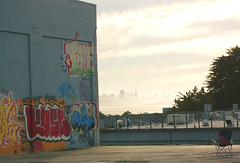
In an era of sensationalism and malevolent media spinning, uplifting facts are sometimes hard to come by. You know as well as I that decades of alarmist rabble-rousing by scientists and forward-thinking individuals has finally awakened the conscience of America to environmental degradation and turned long-absent attention on climactic degradation. Carbon footprint as a household word? Greening as a national pastime? These are signs of an autotelic involution of national consciousness...but is this changing our behavior, not just our minds?
Recent trends say yes. Since 2007, carbon emissions in the United States have dropped 9%, the first decrease in 100 years. Since the beginning of 2009, oil use has dropped 5%, with the same drop reported over the course of 2008. The efficiency of Nuclear power plants in this country have increased from ~60% to above 90% in the last thirty years for the same safety levels, allowing our energy demand from more polluting sources such as coal plants to fall. And it seems the current trends will continue --- California has institutionalized a desire to increase its renewable energy generation from the current 11.8% of the total demand to 33% in eleven years. Bring on the good news!
20090921

20090707
Containerized Creativity
In 1956, trucking entrepreneur Malcom McLean loaded the first payload of standardized shipping containers aboard the refitted tanker ship Ideal-X and watched as they departed Newark for Houston. The implementation of his intermodal dream signaled a sea change for the movement of goods around the world, one in which truck/ship/plane/train all conform to one prescribed rectilinear form, and one in which container loader and receiver are the only parties privy to content while all others are left mystified by identical corrugated monocoque constructions.
This innovation changed not only the physical shape of shipping, but that of its leavings as well. In net importer countries like the United States, used containers pile up in storage lots after their usefulness comes to an end. Having explored these boxy boneyards in person, I've long been inspired to re-use them in the creation of space. No building is free of materials carried in these standards; formalizing the relationship by appropriating the container as containment method is a lovely reminder for future users.
 Graft Architects has crafted the Platoon Kunshthalle arts facility in Korea out of 28 standard shipping containers. In order to utilize the wall-as-structure nature of the containers, they surrounded a central open space with smaller programs (artist live-work, offices, washrooms, etc.)
  which could make use of the container as-is. In doing so they allowed for a sweeping architectural gesture at the heart of the space, at the same time playing with the double-blinding action of fitting any- and everything under the sun into the same blank box.
 Closer to home, DeMaria Design used the basic geometry and structure of the shipping container, but dematerialized it by replacing steel monocoque with glass curtain wall and stucco in places, inverting the relationship of cargo and crate. The resulting Redondo Beach House has an inviting modernist open plan in which the footprint of the shipping industry is still viscerally present.
 Having explored these boxy boneyards in person, I've long been inspired to re-use them in the creation of space. No building is free of materials carried in these standards; formalizing the relationship by appropriating the container as containment method is a lovely reminder for future users.Graft Architects has crafted the Platoon Kunshthalle arts facility in Korea out of 28 standard shipping containers. In order to utilize the wall-as-structure nature of the containers, they surrounded a central open space with smaller programs (artist live-work, offices, washrooms, etc.) which could make use of the container as-is. In doing so they allowed for a sweeping architectural gesture at the heart of the space, at the same time playing with the double-blinding action of fitting any- and everything under the sun into the same blank box.Closer to home, DeMaria Design used the basic geometry and structure of the shipping container, but dematerialized it by replacing steel monocoque with glass curtain wall and stucco in places, inverting the relationship of cargo and crate. The resulting Redondo Beach House has an inviting modernist open plan in which the footprint of the shipping industry is still viscerally present.
Found objects have inspired art since the beginning of time. That this paradigm has continued in contemporary architecture is no surprise --- green meets steel in containerized reconstruction.
20090401
Bone Power
 Whale bone meets power transmission...output formalizing throughput in new ways. The structural object combines relatively new use and traditional surround, a pretty new skin for an oft-abandoned part of modernity. From a firm where metonymy has been more than mentioned...
Beauty? I think so. I wish my local towers were made of older ones, transmuted, equations taken from  nature and refomed.
 nature and refomed.
PG&E, are you listening?
20081013
Wave Power
Despite several public pledges and an ongoing civic discussion about harnessing the Golden Gate's enormous tidal differential as a provider of power for the city of San Francisco, we have yet to see any such system operational in the San Francisco Bay, even on a test or demonstration basis.
 Now it seems we've dragged our feet too long and lost this particular renewable race: the first large scale wave energy farm has its first three generators up and running. Located off the northern coast of Portugal, the Agucadoura generator is a public-private joint venture between a consortium of developers and manufacturers and the Portuguese Energy utility. The three generators (a single generator is shown above) produce ~0.84MW each (for comparison, the average wind turbine currently operational in California produces ~0.03MW). Once the farm is complete, it will produce 22.5MW of energy.
O great Golden Gate, you too will power the citizens that love you...some day.
Now it seems we've dragged our feet too long and lost this particular renewable race: the first large scale wave energy farm has its first three generators up and running. Located off the northern coast of Portugal, the Agucadoura generator is a public-private joint venture between a consortium of developers and manufacturers and the Portuguese Energy utility. The three generators (a single generator is shown above) produce ~0.84MW each (for comparison, the average wind turbine currently operational in California produces ~0.03MW). Once the farm is complete, it will produce 22.5MW of energy.O great Golden Gate, you too will power the citizens that love you...some day.
20080501

20080411
Shed It

For over a year now I've been specifying LED lights for every architectural client who comes my way. I've done this secure in the fact that LEDs are the most efficient way to light a space, providing between 60 and 100 lumens per watt of energy spent (compared to between 12 and 17 lm/W for traditional incandescents).
Recently I've been introduced to the gospel of Plasma lights, an edgy technology which produces about 140 lm/W on average...
So, I think the time has come to change my tune...blacklight warm-up and hyper-efficient white light in a single (tiny) unit? I'm on it.
Subscribe to:
Posts (Atom)